Trade Review and Trading Tips for the Japanese Yen
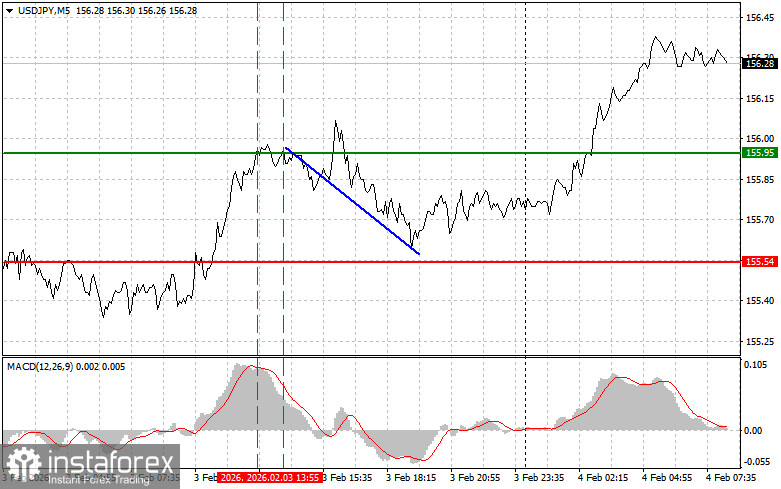
The test of the 155.95 price level coincided with the moment when the MACD indicator had already moved significantly upward from the zero line, which limited the pair's upward potential. For this reason, I did not buy the dollar. The second test of 155.95 led to the implementation of Sell Scenario No. 2, resulting in the pair falling by more than 30 points.
Today, positive data on growth in Japan's services sector business activity index were already released; however, these figures provided no support to the yen. This seemingly paradoxical situation is explained by several interconnected factors that neutralize the positive impact of macroeconomic statistics. First, market attention is focused on the future monetary policy of the Bank of Japan. Despite the positive data, investors remain skeptical about the timing and scale of further interest rate hikes. Second, global factors continue to exert a dominant influence on the yen. The strengthening of the dollar, driven by expectations of a pause in the rate-cut cycle, is putting downward pressure on the Japanese currency. Third, geopolitical uncertainty is also playing a role.
As for the intraday strategy, I will rely more on the implementation of Scenarios No. 1 and No. 2.
Buy Scenarios
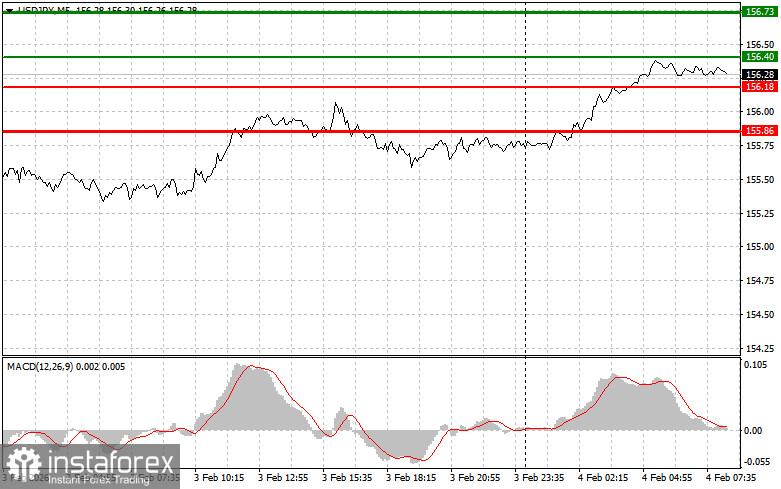
Scenario No. 1: Today, I plan to buy USD/JPY upon reaching the entry point around 156.40 (green line on the chart), with a growth target at 156.73 (the thicker green line on the chart). Around 156.73, I plan to exit long positions and open sell positions in the opposite direction (aiming for a move of 30–35 points in the opposite direction from this level). It is best to return to buying the pair during corrections and significant pullbacks in USD/JPY.Important! Before buying, make sure that the MACD indicator is above the zero line and is just beginning to rise from it.
Scenario No. 2: I also plan to buy USD/JPY today in the event of two consecutive tests of the 156.18 price level while the MACD indicator is in the oversold area. This will limit the pair's downward potential and lead to a reversal of the market upward. Growth toward the opposite levels of 156.40 and 156.73 can be expected.
Sell Scenarios
Scenario No. 1: I plan to sell USD/JPY today only after the 156.18 level is updated (red line on the chart), which will lead to a rapid decline in the pair. The key target for sellers will be the 155.86 level, where I plan to exit sell positions and immediately open buy positions in the opposite direction (aiming for a move of 20–25 points in the opposite direction from this level). It is better to sell as high as possible.Important! Before selling, make sure that the MACD indicator is below the zero line and is just beginning to decline from it.
Scenario No. 2: I also plan to sell USD/JPY today in the event of two consecutive tests of the 156.40 price level while the MACD indicator is in the overbought area. This will limit the pair's upward potential and lead to a reversal of the market downward. A decline toward the opposite levels of 156.18 and 155.86 can be expected.
What's on the Chart
- Thin green line – entry price at which the trading instrument can be bought.
- Thick green line – estimated price where Take Profit orders can be placed or profits can be taken manually, as further growth above this level is unlikely.
- Thin red line – entry price at which the trading instrument can be sold.
- Thick red line – estimated price where Take Profit orders can be placed or profits can be taken manually, as further decline below this level is unlikely.
- MACD indicator. When entering the market, it is important to rely on overbought and oversold zones.
Important. Beginner traders in the Forex market need to be very cautious when making decisions about entering the market. Before the release of important fundamental reports, it is best to stay out of the market to avoid sharp price fluctuations. If you decide to trade during news releases, always place stop orders to minimize losses. Without stop orders, you can very quickly lose your entire deposit, especially if you do not use money management and trade large volumes.
And remember that successful trading requires a clear trading plan, like the one presented by me above. Spontaneous trading decisions based on the current market situation are an inherently losing strategy for an intraday trader.