Trade Analysis and Tips for Trading the British Pound
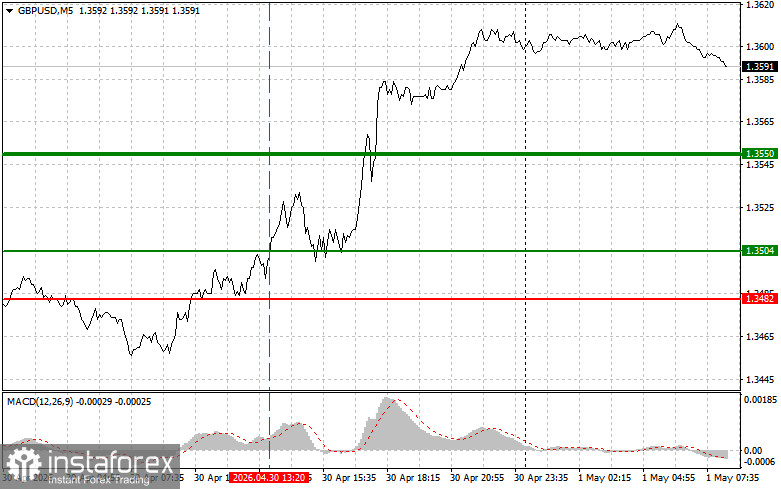
The test of the price at 1.3504 occurred when the MACD indicator had moved up significantly from the zero mark, which limited the pair's upside potential.
The British pound sharply rose after the Bank of England's Monetary Policy Committee voted to keep interest rates unchanged; however, several committee members indicated they were considering a rate hike soon. This decision may have initially seemed neutral, but the comments from committee members added considerable uncertainty and subsequently triggered active buying of the British currency. Investors interpreted the signals as a potential tightening of the Bank of England's monetary policy in the near future, leading them to take more bullish positions in the British currency.
Today promises to be eventful with the release of significant macroeconomic data. In the first half of the day, market participants will focus on data related to the PMI Manufacturing Index. This indicator reflects the health of one of the economy's cornerstone sectors. Its value can provide insights into current production trends and, consequently, the prospects for overall economic growth. In addition to the PMI, data on changes in the monetary aggregate M4 is also expected today. This figure serves as an important indicator of liquidity in the national economy and could signal upcoming inflationary pressures, which the Bank of England has been actively combating lately. The series of key releases will conclude with today's Nationwide House Price Index. Strong figures will lead to a new wave of growth in the British pound.
Regarding the intraday strategy, I will rely more on implementing Scenarios #1 and #2.
Buy Scenarios
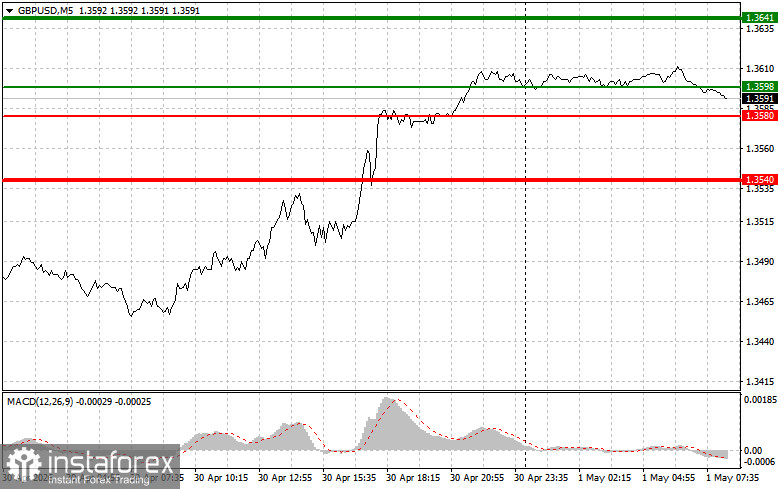
Scenario #1: I plan to buy pounds today upon reaching the entry point around 1.3598 (green line on the chart), with a target increase to 1.3641 (thicker green line on the chart). At around 1.3641, I intend to exit my long positions and open short positions in the opposite direction (expecting a movement of 30-35 pips in the opposite direction from the level). A strong rise in the pound can only be expected after a firm position from the Bank of England. Important! Before buying, ensure that the MACD indicator is above the zero mark and just starting to rise from it.
Scenario #2: I also plan to buy pounds today if there are two consecutive tests of 1.3480 while the MACD indicator is in the oversold area. This will limit the pair's downside potential and lead to an upward market reversal. A rise to the opposite levels of 1.3598 and 1.3641 can be anticipated.
Sell Scenarios
Scenario #1: I plan to sell pounds today after updating the level to 1.3580 (red line on the chart), which will trigger a rapid decline in the pair. The key target for sellers will be the level of 1.3540, where I intend to exit my shorts and also open immediate longs in the opposite direction (expecting a movement of 20-25 pips in the opposite direction from the level). Pressure on the pound may return at any moment. Important! Before selling, ensure that the MACD indicator is below the zero mark and just starting to decline from it.
Scenario #2: I also plan to sell pounds today if there are two consecutive tests of 1.3598 while the MACD indicator is in the overbought area. This will limit the pair's upside potential and lead to a market reversal downward. A decline to the opposite levels of 1.3580 and 1.3540 can be expected.
What is on the Chart:
- The thin green line – entry price at which the trading instrument can be bought;
- The thick green line – approximate price where take profit can be set or to realize profit, as further growth above this level is unlikely;
- The thin red line – entry price at which the trading instrument can be sold;
- The thick red line – approximate price where take profit can be set or to realize profit, as further decline below this level is unlikely;
- MACD indicator. When entering the market, it is important to be guided by overbought and oversold zones.
Important: Beginner traders in the Forex market need to make entry decisions very cautiously. It is best to stay out of the market before important fundamental reports to avoid sharp price fluctuations. If you decide to trade during news releases, always set stop orders to minimize losses. Without placing stop orders, you can quickly lose your entire deposit, especially if you do not use money management and trade in large volumes.
And remember, for successful trading, it is essential to have a clear trading plan, as outlined above. Making impulsive trading decisions based on the current market situation is fundamentally a losing strategy for an intraday trader.